This English translation is provided for convenience only. In the event of any discrepancy, the Polish version shall prevail.
Last updated: 8.06.2026
§ 1. General provisions
- These Terms of Service (the "Terms") set out the rules for the provision of services by electronic means through the website available at qensa.org and the application available at app.qensa.org (jointly, the "Service" or "QENSA").
- The provider and operator of the Service is Neurocore spółka z ograniczoną odpowiedzialnością (a limited liability company) with its registered office in Sośnica, ul. 3 Maja 25, 37-555 Sośnica, entered in the Register of Entrepreneurs of the National Court Register (Krajowy Rejestr Sądowy) under number KRS 0001160402, Tax ID (NIP) 7922326995, Statistical No. (REGON) 541129249 (the "Provider" or "Neurocore").
- The Provider may be contacted at the e-mail address: mail@qensa.org.
- The Terms are made available free of charge in a manner that allows them to be obtained, reproduced, and recorded. They constitute the terms of provision of services by electronic means within the meaning of the Act of 18 July 2002 on the Provision of Services by Electronic Means (ustawa o świadczeniu usług drogą elektroniczną).
- The rules governing the processing of Users' personal data by the Provider acting as controller are described in the Privacy Policy, available at qensa.org/polityka-prywatnosci. The rules governing the processing of personal data entrusted to the Provider in the course of using the Services are set out in § 12 (Entrustment of personal data processing) of these Terms.
§ 2. Definitions
The terms used in these Terms shall have the following meanings:
- Service(s) – services provided by electronic means by the Provider through the Service, including access to the AI assistant for quality departments, under the Plan selected by the User.
- User / Customer – an entrepreneur (a natural person conducting business activity, a legal person, or an organisational unit without legal personality) using the Service for purposes related to its business activity, as well as any person acting on its behalf.
- Account – the User's individual, password-protected panel in the app.qensa.org application.
- Customer Content – any documents, files, data, queries (prompts), and other materials entered into the Service by the User or persons acting on the User's behalf, including procedures, instructions, specifications, reports, complaint documentation, and knowledge bases.
- Generated Content – responses, summaries, reports, and other content generated by the AI Features of the Service on the basis of Customer Content or the User's queries.
- AI Features – features of the Service based on artificial intelligence models made available by the Provider, including through third-party providers.
- Plan – a paid or free-of-charge variant of access to the Service with a defined scope of features and limits.
- GDPR – Regulation (EU) 2016/679 of the European Parliament and of the Council of 27 April 2016 (General Data Protection Regulation; in Polish: RODO).
§ 3. Type and scope of services
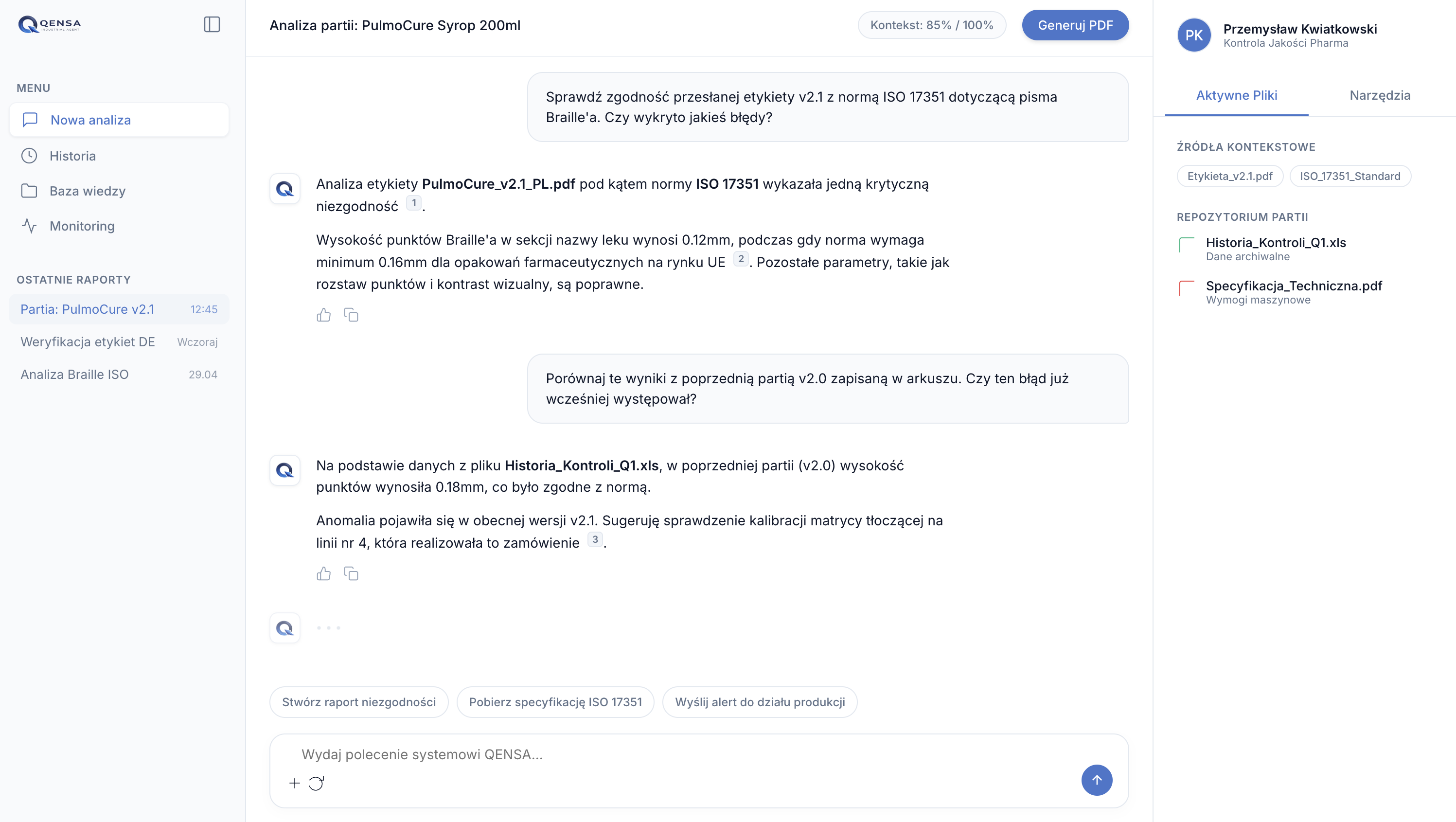
- QENSA is a SaaS (software as a service) tool supporting work with quality documentation, including by searching for information in documents, generating summaries and reports, analysing documents, and working with a company knowledge base.
- The scope of features available to the User depends on the selected Plan and the stage of development of the Service.
- The Provider may additionally offer accompanying services, in particular an AI technology audit, company implementations, and training, on terms agreed separately (§ 8).
- The Service is a supporting tool. Generated Content constitutes auxiliary material and requires verification by the User before use (§ 7).
§ 4. Technical requirements
- Using the Service requires: a device with Internet access, an up-to-date web browser, an active e-mail address, and cookies enabled to the extent necessary for the Service to function.
- The Provider uses its best efforts to keep the Service continuously available, but does not guarantee uninterrupted availability, in particular during periods of testing, development changes, or maintenance work. Technical interruptions, including maintenance, are possible.
§ 5. Registration and Account
- Using the full functionality of the Service requires creating an Account.
- The person creating an Account on behalf of a User represents that they are authorised to represent that entity and to conclude an agreement for the provision of Services on its behalf.
- The User is obliged to provide true and up-to-date data and to protect login credentials against access by unauthorised persons. The User is responsible for the actions of persons using the User's Account.
- The agreement for the provision of Services is concluded upon activation of the Account or – in the case of paid Plans – upon commencement of the provision of the Service under the selected Plan.
- The Provider may enable granting and managing access for multiple users within a single organisation, as well as restricting access to selected resources (role-based access control).
§ 6. Rules of using the Service
- The User undertakes to use the Service in accordance with the law, these Terms, and good practices.
- The following is prohibited in particular:
- providing content of an unlawful nature;
- entering into the Service content that infringes third-party rights, including copyright or trade secrets, without appropriate authorisation;
- taking actions that disrupt the operation of the Service or the security of other Users' data;
- using the Service to train competing AI models or to reverse engineer components of the Service, to the extent permitted by law;
- sharing the Account with unauthorised persons or reselling access without the Provider's consent.
- The Provider may suspend or restrict access to the Service in the event of a reasonable suspicion of a breach of the Terms or of applicable law, as well as in the event of a security threat, after prior notification of the User, unless immediate action is necessary.
§ 7. Customer Content and AI Features
- Rights to Customer Content. The User retains all rights to Customer Content. The User represents that it is authorised to enter Customer Content into the Service and to have it processed in the manner described in these Terms.
- Operational licence. The User grants the Provider a non-exclusive, royalty-free licence to process Customer Content solely to the extent necessary to provide the Service (including transferring it to infrastructure and AI model providers for the purpose of generating responses). The licence expires upon deletion of the Customer Content or termination of the provision of the Service, subject to cases arising from applicable law.
- Rights to Generated Content. As between the parties, Generated Content constitutes Customer Content. The Provider does not claim ownership rights to newly created content. The Provider does not guarantee the exclusivity or uniqueness of Generated Content – in response to similar queries, different Users may receive the same or similar content.
- Nature of the AI Features. The AI Features use technologies that may generate content that is inaccurate, incomplete, or erroneous. Generated Content:
- is auxiliary in nature and should be verified by the User before use;
- does not constitute legal, audit, technical, medical, or other professional advice and does not replace an assessment made by appropriately qualified persons;
- is not intended, on its own, to satisfy the User's regulatory, quality, audit, or other legal obligations; responsibility for decisions made on its basis rests with the User.
- No use for model training. In the configuration used by the Provider, Customer Content is not used to train or fine-tune artificial intelligence models. This commitment arises from the terms of the agreements concluded with the infrastructure and AI model providers and is implemented on the terms specified by those providers.
- The User acknowledges that it should not enter into the Service any data whose processing in the manner described would be inconsistent with the User's internal policies or obligations arising from agreements with third parties.
§ 8. Plans, payments and billing
- The scope and prices of the Plans and additional services are presented in the Service or in an individual offer. Unless indicated otherwise, prices are stated in Polish zloty (PLN).
- Subscriptions (QENSA Plans). Paid Plans are billed on a monthly subscription basis. Payments are processed online through an external payment services provider. By starting a subscription, the User accepts recurring charges to the indicated payment method until cancellation.
- Subscription cancellation. The User may cancel the subscription with effect from the end of the current billing period. Failure to pay for the next period results in suspension or restriction of access to paid features.
- Changes to subscription prices. The Provider may change the prices of subscription Plans. A price change does not apply to the current, already-paid billing period and takes effect from the next billing period. The Provider informs the User of a price change with appropriate advance notice, by electronic means. If the User does not accept the new price, the User may cancel the subscription with effect from the end of the current period; continued use of a paid Plan after the new price takes effect constitutes its acceptance. A change in prices does not constitute an amendment of the Terms within the meaning of § 16.
- AI technology audit and implementation services. These services are billed on the basis of an invoice, on the terms and at the price agreed with the User before commencement of performance, in accordance with an individual offer. Payment is made by bank transfer on the basis of the issued invoice, within the period indicated on it.
- Invoices. The Provider issues invoices in accordance with applicable regulations. The User consents to the issuance and delivery of invoices in electronic form.
- Promotional or trial access. The Provider may make the Service available free of charge as part of promotional campaigns, trials, or industry events. Such access does not require payment or the provision of billing details and may be limited in time or functionality (§ 9).
§ 9. Promotional access and trial versions
- Features made available on a promotional basis or marked as trial/beta are of a developmental nature.
- With respect to such features:
- they are made available on an "as is" basis, without any guarantee of uninterrupted availability, specific parameters, or service level guarantees (SLA);
- they may be changed, limited, suspended, or withdrawn at any time;
- they may not be covered by full technical support.
- The Provider takes care to ensure quality and security also in the case of trial or promotional features; however, the User uses such features taking into account their developmental nature.
§ 10. Liability
- The Provider provides the Services with due diligence.
- To the extent permitted by law, the Provider shall not be liable for:
- decisions made by the User on the basis of Generated Content;
- damage resulting from entering incorrect, incomplete, or unlawful Customer Content into the Service;
- the consequences of using trial or promotional features;
- interruptions or irregularities resulting from causes beyond the Provider's control, including those attributable to infrastructure providers, Internet connections, or the User.
- To the extent permitted by law, the Provider's total liability towards the User under or in connection with the agreement is limited to the amount of the fees paid by the User to the Provider in the 12-month period preceding the event giving rise to the claim. This limitation does not apply to liability that cannot be excluded or limited under mandatory provisions of law.
- Liability for the processing of personal data is governed by the GDPR and § 12 of these Terms. The provisions of this paragraph do not limit liability arising directly from the GDPR.
§ 11. Intellectual property
- The Service, its software, interface, trademarks, and other elements are the property of the Provider or of the entities whose solutions it uses, and are subject to legal protection.
- Use of the Service does not transfer to the User any intellectual property rights to the Service, beyond the scope necessary to use the Service in accordance with these Terms.
§ 12. Entrustment of personal data processing (DPA)
This paragraph constitutes a data processing agreement within the meaning of Article 28 GDPR and is accepted by the User together with the Terms, without the need to conclude a separate document. At the User's request, the Provider may conclude the data processing entrustment in the form of a separate document with content consistent with this paragraph.
- Roles. To the extent that Customer Content contains personal data, the User is the controller of such data, and the Provider is the processor, processing the data solely on the User's documented instructions, the content of which arises from these Terms and from the manner in which the User uses the Service.
- Subject matter, duration, nature and purpose. The subject matter of the entrustment is the processing of personal data for the purpose of providing the Service. Processing continues for the term of the agreement for the provision of Services. The nature and purpose of the processing arise from the features of the Service (including storage, search, document analysis, and content generation).
- Types of data and categories of data subjects. The scope of the data depends on the content entered by the User. This may include, in particular, identification and professional data of persons whose data appears in quality documentation (e.g. the User's employees, auditors, persons submitting complaints). The User undertakes not to enter into the Service special categories of personal data (Article 9 GDPR), unless separately agreed and unless appropriate safeguards have been ensured.
- Obligations of the Provider. The Provider:
- processes data solely on the documented instructions of the controller;
- ensures that persons authorised to process the data have committed themselves to confidentiality;
- applies technical and organisational measures appropriate to the risk, in accordance with Article 32 GDPR, including encryption and access control;
- to the extent possible, assists the controller in responding to requests from data subjects and in fulfilling the obligations under Articles 32–36 GDPR;
- after the end of the provision of the Service, deletes or returns the data in accordance with the controller's choice, unless a retention obligation arises from law;
- makes available to the controller the information necessary to demonstrate compliance with Article 28 GDPR and allows for audits on reasonable terms, with due regard for the security of other customers;
- promptly informs the controller of any identified breach concerning the entrusted personal data.
- Further entrustment (sub-processors). The User grants general authorisation for the Provider to engage further processors (sub-processors), in particular from the following categories: a cloud infrastructure provider in the European Union and providers of artificial intelligence models made available via an API. The Provider ensures that sub-processors are bound by data protection obligations corresponding to the obligations set out in this paragraph.
- List of sub-processors and objection. The current list of sub-processors, together with their function and location, is made available upon the User's request. The Provider informs the controller of its intention to engage a new sub-processor or to change a sub-processor with sufficient advance notice to allow an objection to be raised. In the event of a justified objection, the parties shall seek a solution in good faith; if this is not possible, the User may terminate the agreement with respect to the service concerned by the objection.
- Data location and transfers. Customer Content is stored and processed in the European Union region. Technical and ancillary data not covered by the above principle may be processed in other locations in accordance with the agreements with the providers. If processing involves the transfer of data outside the European Economic Area, it takes place on the basis of mechanisms compliant with Chapter V GDPR (in particular standard contractual clauses).
- No model training. Entrusted personal data is not used to train or fine-tune artificial intelligence models, in accordance with § 7(5).
§ 13. Complaints
- Complaints regarding the Services may be submitted to the e-mail address mail@qensa.org.
- A complaint should include contact details and a description of the objections.
- The Provider considers a complaint within 14 days of its receipt and informs the complainant of the outcome.
§ 14. Term and termination of the agreement
- The agreement for the provision of Services is concluded for an indefinite period, unless it concerns a specific billing period or a one-off service.
- The User may withdraw from the Service at any time by deleting the Account or cancelling the subscription, with effect as set out in § 8.
- The Provider may terminate the agreement with 14 days' notice, and in the event of a material breach of the Terms by the User – with immediate effect, after an ineffective request to cease the breach.
- After termination of the agreement, Customer Content is deleted or returned in accordance with § 12(4)(e).
§ 15. Provisions concerning entrepreneurs with consumer rights
- In the case of a User who is a natural person concluding an agreement directly related to their business activity, where the agreement is not of a professional nature for that person (an entrepreneur with consumer rights), consumer protection provisions apply to the extent arising from the Act on Consumer Rights (ustawa o prawach konsumenta), including those concerning the right of withdrawal from a distance agreement.
- Such a User may withdraw from the agreement within 14 days without giving any reason, subject to the exceptions provided for by law, in particular where the provision of a digital service began with the User's express consent before the expiry of the withdrawal period.
§ 16. Amendments to the Terms
- The Provider may amend the Terms for important reasons, in particular changes in the law, the scope of the Services, or security considerations.
- The Provider informs of amendments with appropriate advance notice, in particular by electronic means. Continued use of the Service after the amendments take effect constitutes their acceptance; a User who does not accept the amendments may terminate the agreement.
§ 17. Final provisions
- In matters not regulated herein, the provisions of Polish law apply, in particular the Civil Code (Kodeks cywilny), the Act on the Provision of Services by Electronic Means (ustawa o świadczeniu usług drogą elektroniczną), and the GDPR.
- Any disputes with a User who is neither a consumer nor an entrepreneur with consumer rights shall be resolved by the court with territorial jurisdiction over the Provider's registered office.
- If any provision of the Terms proves to be invalid, the remaining provisions remain in force.
- The Terms enter into force on 8.06.2026.